
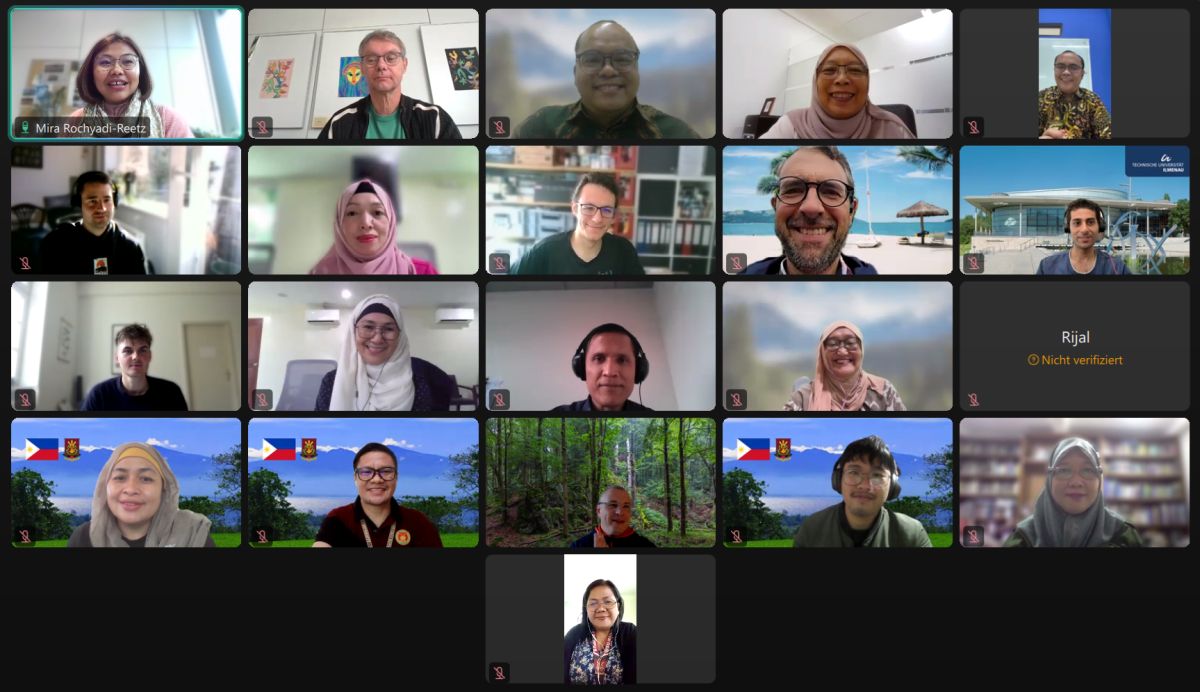
The GreenTrans-Edu consortium held its first online symposium on 16 September 2025, bringing together 24 scientists from partner universities to align research priorities and strengthen collaboration. The symposium focused on two main research areas: Soil Quality (SDG 15) and Energy Transformation (SDG 7), aiming to foster joint research, publications, and practical applications across participating institutions.
The Soil Quality Research Group presented ongoing studies on forest and agricultural soils, particularly particle size and water retention capacity. FH Erfurt introduced its new THURNABOUT laboratory, enabling advanced soil physics analyses. Meanwhile, the team from President University proposed integrating environmental, socio-economic, and policy dimensions into comparative studies across Germany, the Philippines, and Indonesia. Discussions highlighted opportunities for digital soil mapping using AI and collaboration in microbiological soil analysis, leveraging expertise from Mindanao State University.
The Energy Transformation Research Group shared developments in small-scale renewable energy systems. Scientists from Pancasila University presented field-tested hydropower technologies in an Indonesian village, while researchers from TU Ilmenau discussed DC distribution networks and Thermal Energy Storage (TES) systems for Carnot batteries. The consortium explored the potential for off-grid hybrid energy solutions combining hydropower and solar PV, well-suited for local climates with only two seasons: dry and rainy. Plans were also made to conduct a resource assessment study to evaluate the technical and economic feasibility of implementing renewable energy systems in partner villages. Overall, the online symposium reinforced the consortium’s commitment to collaborative research, capacity building, and innovative solutions in sustainable land use and renewable energy. By combining technical expertise with socio-economic insights, GreenTrans-Edu aims to generate actionable knowledge to address global challenges in climate and sustainability.